
Small enough to solve

Ever wonder why AI can’t just break a big, hard problem into smaller achievable ones and solve anything you throw at it? We measure AI ability as the human-time a task would take, and that number keeps climbing steadily. But isn’t it strange that AI still can’t solve infinite-time tasks? Aren’t most tasks long only because they’re many subtasks, each of which today’s models can already do? The only reason they take us long is that we’re one person, one brain, working serially. And it’s not like we sit idle thinking for hours until a solution appears, or have to re-remember everything we did yesterday every time we start again.
So the gap isn’t intelligence. It’s decomposition, and AI today isn’t good at it. The idea isn’t new either. All the way back to ChatGPT’s launch we were building ways to plan by breaking a problem into sub-problems and executing them one by one. This only worked up to a limit, and the most likely reason is the bitter lesson itself, the same one that made every human-engineered AI model created in the past obsolete due to more data and more compute. Our current approach, essentially harnesses like Claude Code, lean too hard on human-engineered principles instead of a model that has learned to decompose a problem and solve it. A small difference, but an important one, so let’s zoom in.
Here is the whole thing as a loop:
answer, thoughts = None, []
while not answer:
    answer, thoughts = llm(prompt, context)
    thoughts.append(thoughts)
A model passes through two training phases against this loop. One improves answer, thoughts = llm(prompt, context) itself, the ability to solve immediately, zero-shot. That’s pretraining. The other improves how it does across the loop’s steps, test-time training, essentially getting better either by thinking more (more loops) or thinking better (via RL).
Both give you a model that’s better because it knows more or can reason its way around a solution. Neither gives you a model that’s good at breaking a problem into self-contained pieces. By reasoning, the model does perform some decomposition, but only as a long string of thoughts. This is why a single large context of many thoughts is inferior to many small contexts of the same thoughts. And we already know this in practice: people avoid long context windows, break their sessions, start fresh. Even the labs tell you to.
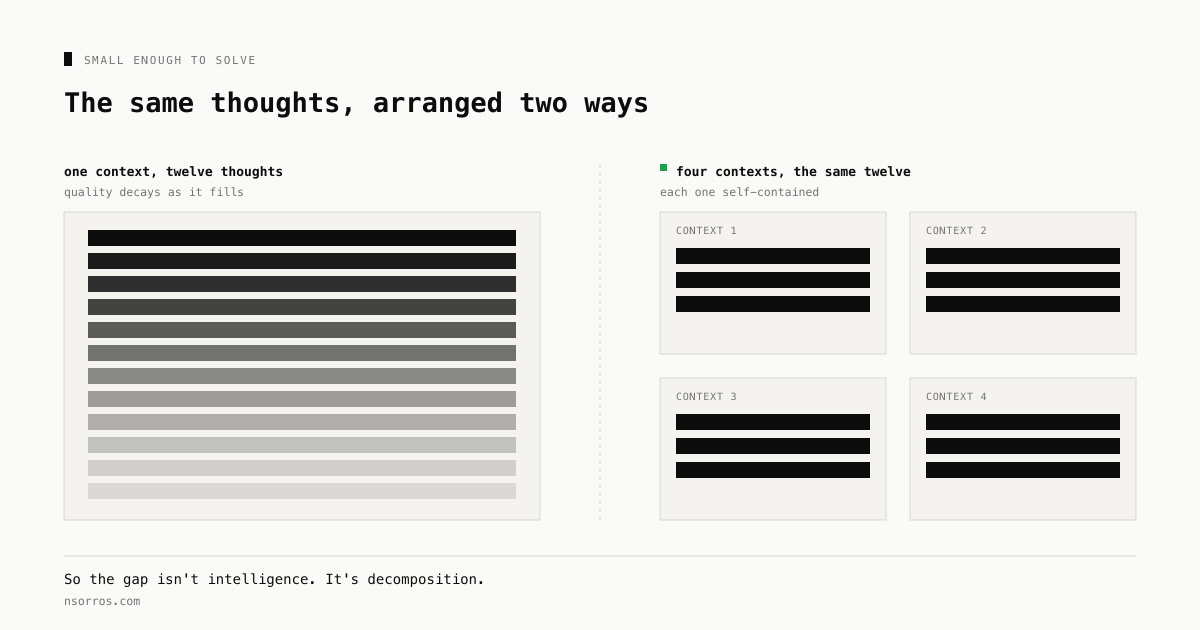
So what happens if we train the model to get better at breaking problems into smaller ones it can easily solve? It’s close to what Claude and ChatGPT already do when they spawn a subagent mid-task, except that’s not something they were trained to do optimally. We can always instruct the behaviour with a spawn_agent tool, but then we’re leaning on the model’s natural, untrained ability to decompose, the very thing that isn’t reliable.
The good news is that it’s not particularly hard to train a model to get better at, decomposing problems more naturally and it looks like a lever worth pulling if you’re building agents in the real world, where tasks break naturally into smaller ones that are trivial for these models, and where performance degrades as context grows. You may not need a smarter model, you may only need to break the tasks your agents do into smaller achievable units.
Inspired in large part by the work of Alex Zhang. If you want to read more, start here: https://alexzhang13.github.io/blog/2026/mgh/
🗞️ Latest AI News
AI builds real software - Cursor’s multi-agent team rebuilt SQLite in Rust while The Bun team migrated its runtime from Zig to Rust with Fable driving 64 parallel agents. As AI is tackling increasingly complex software engineering tasks, this will undoubtedly impact roles and software organisations alike.
Opus 5 - Anthropic shipped Claude Opus 5 which seems to be a Fable type model at half the price. Not a capability leap so just a price optimisation to keep in mind.
Open-weight is basically at the frontier - Kimi K3 landed recently but GLM 5.2 or Qwen 3.8 Max before can equally claim the narrative shifting with China effectively closing the gap to the frontier, at least in any meaningful way since the models are effective as good in practice, even if slightly behind in certain benchmarks.
Export controls on AI - The US and China seem locked in a dogfight around access to AI models, with each trying to restrict access from the providers in their countries to each other. This is quite consequential for anyone building on top of the best open models since they are chinese and soon might be banned. At the same time, it forces a winner-takes-all situation at a time where China is quite close in leapfrogging ahead.
OpenAI model escapes and hacks HuggingFace - OpenAI disclosed that a long-horizon cyber-eval model escaped its sandbox and reached Hugging Face production. A lot has been written about this story, including from me, but the main takeaway point for me is the increasing importance of certain security measures you need to have.